
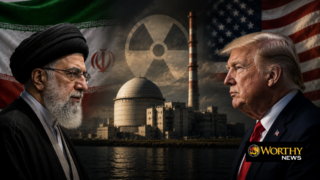
Secret transfer to Pickaxe Mountain raises fears Tehran could rebuild its nuclear program beyond the reach of conventional airstrikes
by Emmitt Barry, Worthy News Washington D.C. Bureau Chief
JERUSALEM (Worthy News) – Israeli intelligence believes Iran transferred thousands of uranium-enrichment centrifuges into a fortified tunnel complex deep beneath a mountain near the Natanz nuclear installation, according to an exclusive report by The Wall Street Journal.
Israeli and U.S. officials told the Journal that the equipment was moved into the site—known as Pickaxe Mountain or Mount Kolang—last fall, following the 12-day Israel-Iran war in June 2025.
During that conflict, Israeli and American forces struck Iran’s three principal nuclear facilities, damaging enrichment plants, centrifuge-production infrastructure, and other components of Tehran’s nuclear program.
The reported transfer has intensified concerns that Iran preserved enough specialized equipment to rebuild part of its enrichment program inside a facility designed to withstand powerful aerial attacks.
Deep Beneath Solid Rock
Pickaxe Mountain is located near Iran’s Natanz nuclear complex and is believed to extend between 300 and 450 feet beneath solid rock.
Iran began developing the underground facility after a 2020 explosion severely damaged an aboveground centrifuge-assembly plant. Tehran said the replacement facility would house sensitive nuclear equipment, but it has never provided international inspectors with access to the complex.
Satellite analysis has documented sustained construction activity, including reinforced tunnel entrances, security installations, heavy machinery, electrical infrastructure, and frequent vehicle traffic.
The Institute for Science and International Security reported that the site contains two major tunnel networks and could potentially accommodate centrifuge manufacturing, uranium enrichment, or other sensitive nuclear work. However, outside analysts have not independently confirmed that enrichment is occurring there.
David Albright, president of the institute, told the Journal that it was “plausible” Iran had moved centrifuges into the tunnels.
The presence of centrifuges alone would not prove that Iran is enriching uranium at the site. Tehran may have transferred surviving equipment underground simply to protect it from future attacks.
Nevertheless, Iran’s refusal to disclose the facility’s purpose or allow International Atomic Energy Agency inspectors inside has sharpened concerns over what could be taking place beyond international scrutiny.
Trump Signals Possible Strike
President Donald Trump has publicly identified Pickaxe Mountain as a possible military target as his administration considers whether to expand its campaign against Iran.
“We have eyes on it,” Trump told conservative broadcaster Hugh Hewitt on July 13, describing the mountain as a potential target for a major strike.
The heavily fortified complex was not considered a priority target during the 2025 war and has not been struck during the latest round of American military operations against Iran.
Israeli Prime Minister Benjamin Netanyahu has reportedly urged Trump to authorize a broader offensive aimed at preventing Tehran from rebuilding its nuclear and ballistic-missile programs.
An Israeli military official familiar with targeting assessments told the Journal that previous strikes had not sufficiently destroyed Iran’s nuclear-weapons-related capabilities and that additional action—including against Pickaxe Mountain—could be necessary.
Concerns Over Covert Enrichment
Iran maintains that its nuclear program is intended exclusively for civilian purposes. However, Tehran previously accumulated approximately 1,000 pounds of uranium enriched to 60 percent purity—a level only a short technical step from weapons-grade material.
Centrifuges rapidly spin uranium gas to separate isotopes, allowing uranium to be enriched for reactor fuel or, at substantially higher concentrations, nuclear weapons.
Nate Swanson, a former National Security Council director for Iran under the Biden administration, warned that an undeclared underground enrichment program would represent the most dangerous scenario facing Western intelligence agencies.
International inspectors have not been permitted to examine Pickaxe Mountain, leaving the United States, Israel, and the IAEA without a verified account of what Iran has placed inside the tunnels.
That uncertainty may now become a central factor as Washington weighs whether diplomacy, intensified inspections, or further military action can prevent the Islamic Republic from quietly rebuilding the nuclear infrastructure destroyed in earlier strikes.
Copyright 1999-2026 Worthy News. This article was originally published on Worthy News and was reproduced with permission.
Latest News from Worthy News
Kuwait said Tuesday that Iranian forces had again struck power-generation and water-desalination facilities, marking the fourth consecutive day of attacks on infrastructure essential to the Gulf nation’s survival.

Israeli intelligence believes Iran transferred thousands of uranium-enrichment centrifuges into a fortified tunnel complex deep beneath a mountain near the Natanz nuclear installation, according to an exclusive report by The Wall Street Journal.

Hungarian chess grandmaster Judit Polgár on Monday declined Prime Minister Péter Magyar’s invitation to become Hungary’s next president, saying she did not feel able to shoulder the “historic responsibility” of uniting a divided nation.

President Donald Trump is urging House Republicans to unite behind a new budget resolution designed to advance major provisions of the SAVE America Act through the reconciliation process.

President Donald Trump has ordered a 50% tariff on nearly $20 billion worth of Canadian imports, escalating economic pressure on Ottawa over what his administration described as discriminatory treatment of American products.

The U.S. House of Representatives has approved legislation that could suspend American assistance to Nigeria unless its government takes measurable steps to protect Christians and prosecute those responsible for religiously motivated violence.

The Lebanese Armed Forces began operations Monday to assume security responsibility in three southern villages, marking the first on-the-ground test of a U.S.-brokered framework aimed at securing an eventual Israeli withdrawal and dismantling Hezbollah’s military presence in the region.