
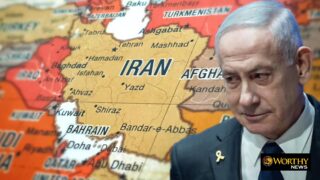
Speaking in Dimona after an apparent visit to Israel’s secretive nuclear research center, the prime minister warned Tehran that any renewed attack would trigger an unprecedented response.
by Emmitt Barry, Worthy News Washington D.C. Bureau Chief
JERUSALEM (Worthy News) – Israeli Prime Minister Benjamin Netanyahu issued a blunt warning to Iran on Tuesday, declaring that any renewed attack against Israel would be met with a response far more powerful than the military action Tehran has already witnessed.
Speaking at the Negev Conference in the southern Israeli city of Dimona, Netanyahu told Iran’s leaders not to assume that a future confrontation would follow the same pattern as previous exchanges.
“We are prepared for every scenario,” Netanyahu said. “I can tell you one thing, and I’ll say it to Iran’s leaders: Don’t count on things staying quiet if you attack us.”
“Don’t count on a rerun,” he continued. “Because this will not be a rerun, and the last one was powerful enough. This will be a different broadcast, far more powerful.”
Netanyahu said Israel would no longer tolerate attacks without imposing a substantially greater cost on those responsible.
“The days are over when someone hits us and we don’t hit back twice as hard,” he said. “We did that to the axis of evil in Iran, and we will keep doing it to anyone who attacks us. That’s how we operate.”
The warning came amid continuing regional tensions and repeated exchanges involving Iran, Israel, the United States, and Tehran’s network of terrorist proxies across the Middle East.
Although Israel has reportedly remained outside the latest round of direct U.S. strikes against Iranian military targets, Netanyahu’s remarks made clear that Jerusalem is prepared to act decisively if Iranian forces again attack Israeli territory.
Netanyahu References Dimona ‘Textile Factory’
Netanyahu also appeared to disclose that he had visited the Shimon Peres Negev Nuclear Research Center near Dimona earlier Tuesday.
The prime minister referred to the highly sensitive facility using the phrase “textile factory,” a term associated for decades with Israel’s policy of nuclear ambiguity.
Netanyahu made the reference while discussing the government’s efforts to rebuild communities near the Gaza border that were devastated during the Hamas-led massacre on October 7, 2023.
“When I met with my wife Sara at Kibbutz Be’eri and Kibbutz Kfar Aza last summer, I said in clear words there that we would rebuild the Gaza border region devastated by the terrible October 7 massacre several times over,” Netanyahu said.
“And that’s what we’re doing in practice; it’s not just words,” he added, praising the work of Tekuma Directorate head Moshe Edri.
“We visited him there, where they make textiles, at the textile factory,” Netanyahu said. “He’s doing wonderful work there, wonderful work in the Tekuma region.”
The “textile factory” description dates to the early history of the Dimona facility, when Israeli officials used civilian terminology to conceal the nature of its construction. Israel has never publicly confirmed or denied possessing nuclear weapons, maintaining a deliberate policy of ambiguity.
Foreign governments, intelligence agencies, and international analysts have long identified the Dimona site as the center of Israel’s undeclared nuclear program. The facility was formally renamed the Shimon Peres Negev Nuclear Research Center in 2016.
Netanyahu’s decision to reference a visit to the site on the same day that he delivered an unusually forceful warning to Iran appeared calculated to send a broader strategic message.
While the prime minister made no explicit nuclear threat, the timing and location of his remarks were unlikely to be overlooked in Tehran.
Israel’s message was unmistakable: The Jewish state will not absorb another Iranian assault quietly, and its leaders intend to preserve every available option to defend the country and its people.
Copyright 1999-2026 Worthy News. This article was originally published on Worthy News and was reproduced with permission.
Latest News from Worthy News

U.S. inflation slowed sharply in June as gasoline and other energy prices retreated, delivering welcome relief to American households even as renewed fighting with Iran threatens to push fuel costs higher again.

Idaho voters will decide this November whether to dismantle one of the nation’s strongest protections for unborn children, placing the deeply conservative state at the center of the continuing national battle over abortion.
Saudi-led forces carried out overnight airstrikes against Yemen’s northwestern Saada province after the Iran-backed Houthi terrorist organization launched ballistic missiles and drones toward an international airport and military installations inside Saudi Arabia.
Israeli Prime Minister Benjamin Netanyahu issued a blunt warning to Iran on Tuesday, declaring that any renewed attack against Israel would be met with a response far more powerful than the military action Tehran has already witnessed.

United States forces carried out a third consecutive night of strikes against Iran, targeting military sites along the Islamic Republic’s coastline and near the strategically vital Strait of Hormuz, U.S. Central Command confirmed.
Iran-backed Houthi terrorists launched ballistic missiles and drones toward Saudi Arabia’s Abha International Airport on Monday, sharply escalating tensions along the kingdom’s southern border and threatening years of relative calm in Yemen.

Anglican leaders have approved an ambitious initiative to plant or restore one million churches worldwide over the next decade, with the goal of bringing congregations closer to local communities and welcoming an estimated 20 million new believers.